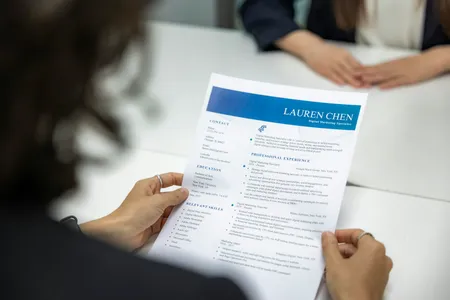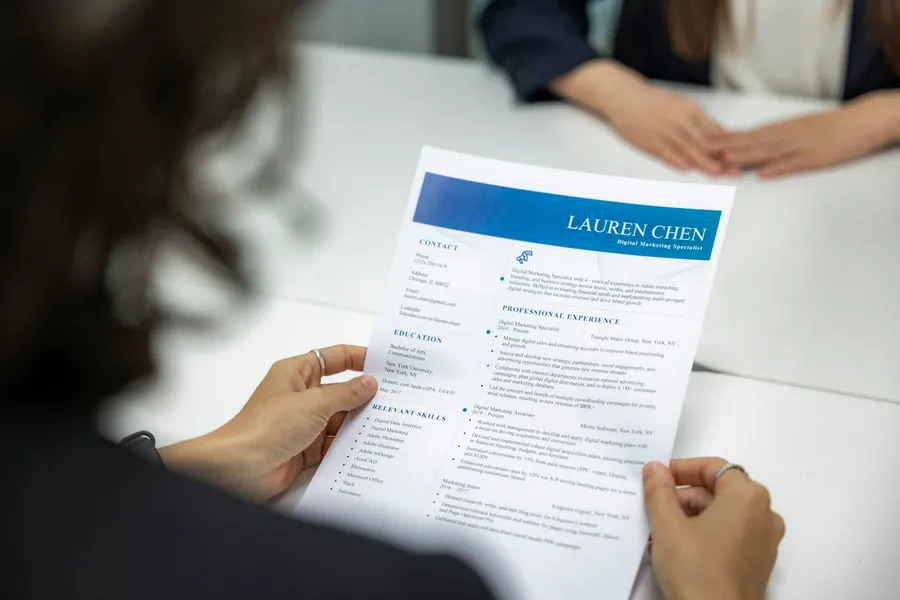
Picture a hiring manager with a stack of applications and a meeting in ten minutes. Your resume gets a quick look, and what she sees in that look decides whether she reads on. That is the job of a resume: not to tell your whole story, but to earn the second look.
This guide walks through how to build one from a blank page. You will pick a format, fill each section, rewrite weak bullets, clean up the formatting and run a final check. The advice draws on federal hiring pages and university career centers, and where the evidence is thin we say so.
Key takeaways
- Write for a fast reader. Put titles, employers, dates and your strongest results where the eye lands first.
- Start from the job posting, and use only true statements in its language.
- Bullets should say what changed because of your work, not just what you were assigned.
- Plain formatting beats clever design. Proofread twice, then ask someone else.
How fast is the first read, really?
You have probably heard that recruiters spend six seconds on a resume. The number traces to a 2012 eye-tracking study of about 30 recruiters run by the job site TheLadders. A recent article from the job-search company Simplify points out that the study was small and is now about fourteen years old, so treat six seconds as a rough gauge, not a rule. The same article describes the glance as triage: a keep-or-skip decision, with a closer read for resumes that pass.
Federal hiring pages give a similar test. The Treasury Department’s resume advice suggests checking that a reader can see your main credentials within 10 to 15 seconds.
Two practical lessons follow. First, the top third of page one matters most, so your current or most relevant role, and the dates, should be easy to find. Second, a resume that is easy to skim is not a dumbed-down resume. It is one where a tired reader does not have to work.
Start with the job posting
Before you type, read the posting twice. The first time, read for the job. The second time, highlight the duties and qualifications that repeat, since those are what the employer will be looking for.
Treasury’s guidance tells applicants to review the duties, qualifications and evaluation criteria first, then show how they meet each one in plain language and in the same terms the announcement uses. NIST adds a warning that applies well beyond government: reviewers will not infer skills from a job title or a vague statement, so state them.
Try this quick exercise.
- Copy the five to eight requirements that appear most in the posting.
- Next to each, write one real example from work, school, volunteering or a project.
- Note the number, outcome or result if you have one.
- Use the strongest examples first in your bullets.
If a requirement has no matching example, that is useful information. Do not invent one. You can mention a related skill honestly, or accept that this job may be a stretch. For the full process, see our guide to tailoring your resume for every application.
Pick a format and a length
Most people should use a reverse-chronological layout: newest job first, with dates visible. Readers and screening software both expect it.
| Format | Best for | Watch out for |
|---|---|---|
| Chronological | Steady work history that relates to the target job | Gaps and unrelated jobs are easy to see |
| Combination | Career changers with transferable skills | Can run long; keep the skills block tight |
| Skills-based (functional) | Rarely the best choice, even with little history | Hides dates, which many readers distrust |
How long should it be?
The sources agree more than you might expect. Holy Cross recommends a single page for students. San José State’s School of Information says one to two pages. Federal resumes, per NIST and Treasury, are capped at two pages under OPM’s 2025 Merit Hiring Plan.
A workable rule: one page if you have under about ten years of relevant experience, two if the extra page is full of relevant material. If you go to two, make page one strong enough to stand alone. Do not shrink the font to squeeze things in. Cut older or weaker content instead.
Build the sections in order
A predictable order helps a skimming reader find what they need.
Header
Include your name, city and state, phone number and a professional email address. A LinkedIn or portfolio link is fine if the page is up to date. Holy Cross’s advice is simple: keep your contact information current, since an employer who cannot reach you cannot hire you. You do not need your full street address.
Leave out a photo, age, religion, marital status and any Social Security number. Treasury’s federal guidance names these as items to exclude.
Summary
Two or three lines: what you do, your strongest qualifications and the kind of role you want. Compare these two openings.
- Weak: “Hard-working team player seeking a challenging opportunity.”
- Stronger: “Customer service representative with four years in high-volume retail, experienced in returns, scheduling and training new hires. Looking for an operations coordinator role.”
The second one can be checked. The first could describe anyone.
Experience
For each role, list job title, employer, city and state, and dates. Treasury and NIST both ask federal applicants for month and year, and weekly hours; that level of detail is a good habit for any application. Add three to five bullets, with the most relevant first. Older or unrelated jobs can shrink to one line or drop off.
Skills
Group them by type, such as software, languages or certifications. List skills you could use on day one, and tie them to the posting. A long list of everything you have ever touched makes the real strengths harder to see.
Education and training
Degree or program, school and completion year. Recent graduates usually put this near the top. Experienced workers usually place it lower. Add licenses and certifications that the job requires.
Optional sections
Volunteer work, projects, awards and languages can help if they support the application. Treasury notes that volunteer and community roles can count as experience. Holy Cross also suggests making leadership roles easy to spot, and explaining campus acronyms an outsider would not know.
Write bullets that show results
Most weak resumes fail here. A bullet that lists a duty tells the reader what your boss wanted. A bullet that shows a result tells the reader what you did.
A simple pattern: start with a verb, say what you did, then say what changed or how much. Treasury’s advice is to describe results with numbers, percentages or dollar amounts where you can.
| Before | After |
|---|---|
| Responsible for answering phones | Answered calls for a six-person office, routed requests and logged each one in the scheduling system |
| Worked with the team on projects | Coordinated with three coworkers to finish weekly deliveries on schedule |
| Helped with training | Trained five new hires on cash handling and opening procedures |
| Handled customer complaints | Resolved complaints at the register, which cut the number of escalations to the manager |
Notice that the “after” lines use only details you could back up from memory, a schedule or an old email. That matters.
Do not invent numbers
Pull figures from your own records, performance reviews or a quick check with a former coworker. If you cannot measure the outcome, describe it plainly. A made-up statistic is easy to get caught on in an interview, and an inflated claim can undo an otherwise good application.
Questions to ask for each job
If you are stuck, answer these in rough notes, then trim them into bullets.
- What did I do that no one had to remind me to do?
- What got faster, cheaper, safer, cleaner or more accurate because of me?
- How many people, customers, items or dollars did I handle?
- Did I train someone, fix a process or solve a recurring problem?
- Did I get praise, a promotion or extra responsibility? Why?
Verbs and tense
Use a mix of accurate verbs such as managed, organized, trained, built, reduced, scheduled, resolved, prepared, coordinated, analyzed and delivered. Avoid starting every bullet the same way. Career centers at San José State and elsewhere advise present tense for your current job and past tense for earlier ones.
Put it together: one sample entry
Here is how the pieces look in a single role. The details are made up for illustration.
Store Operations Associate, Greenfield Hardware, Dayton, OH, June 2022 to present
- Opened and closed the store on a rotating schedule, completing cash-outs with no recurring discrepancies noted by the manager
- Trained four new hires on the register and returns policy during their first two weeks
- Reorganized the paint aisle by product type, which made restocking faster and cut customer questions about where items were
Each line starts with a verb, names something specific and points to an outcome. None of them needs an invented percentage. If you have a real figure, use it. If you do not, a plain, believable result is better than a shaky number.
Should you use AI to help?
Many people now draft with an AI tool. The risk is sameness. NIST warns federal applicants that AI-generated, plagiarized or recycled content may get them removed from consideration, and a generic summary says little about you.
If you use a tool, give it your real facts and ask for edits, not inventions. Then read every line and delete anything you cannot explain in an interview. If an interviewer asks about a bullet and you cannot talk about it, the bullet is a liability.
Keep the formatting boring
Formatting is not where you win the job, but it is where you can lose attention. The career-center advice is fairly consistent.
- Use a standard font such as Arial, Calibri, Verdana or Times New Roman, at 10 to 12 points. San José State recommends this range. Federal guidance suggests a sans-serif body at 10 points with larger headings.
- Keep margins reasonable. Treasury suggests half an inch.
- Avoid lines, graphics, color and columns, as San José State advises. They can look fine to you and scramble in screening software.
- Use consistent dates, spacing and bullet style throughout.
- Save as a PDF unless the employer asks for another format. Treasury asks for PDFs under 5 MB for federal applications.
This is one area where employers differ. Some application systems prefer a Word file or ask you to paste text into a form. Follow the posting’s instructions first. For more on what screening software does and does not do, read our explainer on automated resume screening.
Leave out what does not help
Cutting is part of writing.
- References. San José State advises against listing them or adding “references provided on request.” Keep a separate sheet ready.
- Objective statements that only describe what you want.
- Job duties from ten or more years ago that do not relate to the target role.
- Personal details, photos and anything an employer cannot legally or reasonably use.
- Jargon and internal acronyms. Treasury advises plain language, and Holy Cross says to explain terms outsiders may not know.
If you have little experience
You still have material. Include class projects, volunteering, part-time jobs, clubs, leadership roles and personal projects. Treasury notes that volunteer and community experience can count when it is relevant.
Lead with a skills or projects section if it is stronger than your work history, then keep the format chronological so readers can still find dates. Our guides to building a project portfolio with no job experience and showing self-taught skills go deeper. If you have a gap in your work history, the right move is to be matter-of-fact and brief. See how to explain career gaps.
A two-minute test
Hand your resume to a friend for two minutes, then take it back. Ask what they remember about you. If it is not what you wanted the employer to remember, move those details higher or rewrite the summary.
A note on federal resumes
Federal jobs follow different rules, so do not reuse a private-sector resume unchanged. According to NIST and Treasury, federal resumes are capped at two pages. They also ask for more detail than most private employers: month and year dates, hours per week and specific duties and accomplishments tied to each requirement. NIST recommends building your resume in the USAJOBS Resume Builder when you can, and warns that AI-generated, plagiarized or recycled content may get an application removed.
If you are applying for both federal and private jobs, keep two versions. The federal one can be longer and more detailed. The private one should be tighter.
Common resume mistakes
The mistakes that cost the most
Small errors suggest carelessness, and a mismatch with the posting suggests you did not read it.
- Typos and inconsistent formatting. Holy Cross notes that even small grammar or spelling errors can hurt your chances.
- One generic resume sent to every job.
- Paragraphs instead of short bullets.
- Duties without results.
- An unprofessional email address or a stale phone number.
- Unexplained dates that do not add up, or very short stints with no context.
- Fancy templates, tables and text boxes that software cannot read cleanly.
- Content copied from a template or from a sample resume. Reviewers can often tell, and it can sound like everyone else.
- Claims you cannot support. Do not stretch titles, dates, degrees or numbers. This is general information and not legal advice, but misstatements can lead to a rescinded offer or dismissal if discovered.
A final check before you send
Run through this list for every version.
- Read it aloud, slowly. Your ear catches what your eye skips.
- Check every date, phone number, email and spelling of every company name.
- Confirm the top third of page one shows your strongest, most relevant material.
- Compare it to the posting. Is each major requirement addressed with a real example?
- Check formatting: consistent fonts, bullets, spacing and tense.
- Save the file with a clear name, such as “Jordan-Lee-Resume.pdf.”
- Ask someone with a good eye for detail to read it. Treasury recommends this step.
Keep a master version current
Update the resume every few months, even if you are not looking. Add new results, tools and training while you still remember the details. A current document lets you answer a recruiter’s message the same day.
A practical setup: keep a long master document with every job, project, number and skill. For each application, copy it, then cut it down to the one or two pages that fit that posting. Track what you sent and when with a job application tracker, so you remember which version went where.
If you also keep a LinkedIn profile, treat it as a companion, not a copy. Our comparison of LinkedIn profile vs. resume explains what belongs where.
Most colleges, workforce centers and public libraries offer free resume reviews. Holy Cross and San José State both point students to their career centers for this. If you are not a student, ask your local American Job Center or library what they offer.
The bottom line
A good resume is not clever. It is clear, honest and aimed at one reader. Plan to spend more time on the first third of page one and on your bullets than on anything else.
Next steps:
- Pick one job posting and list the five requirements that repeat.
- Rewrite your three weakest bullets using the verb, action and result pattern.
- Strip formatting down to one font, simple headings and no graphics.
- Proofread aloud, then ask a friend to read it for two minutes.
- Save the master version, and copy it for each new application.
No resume guarantees an interview, and results depend on the job market, the employer and your fit. What you can control is making it easy for a reader to see that you can do the work.